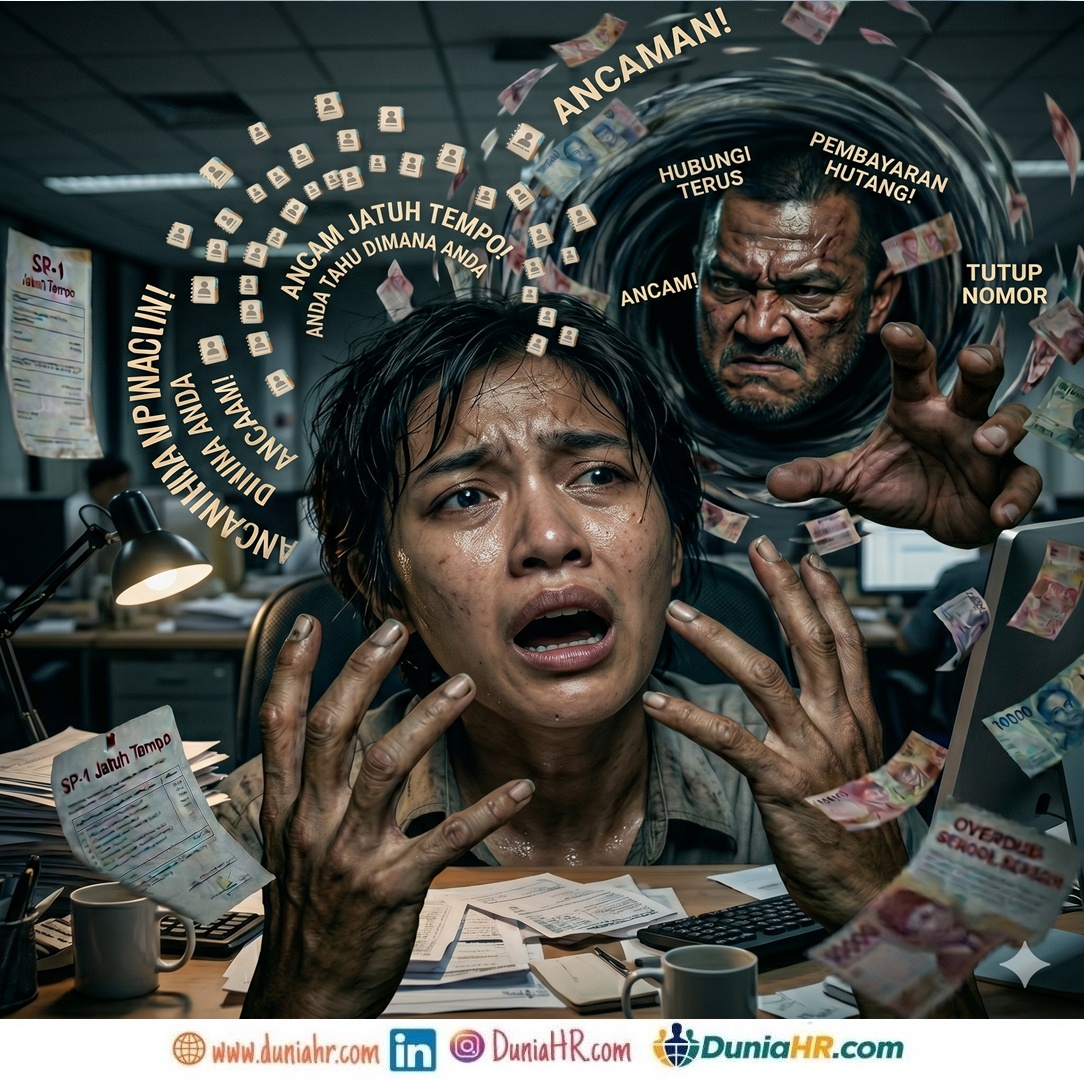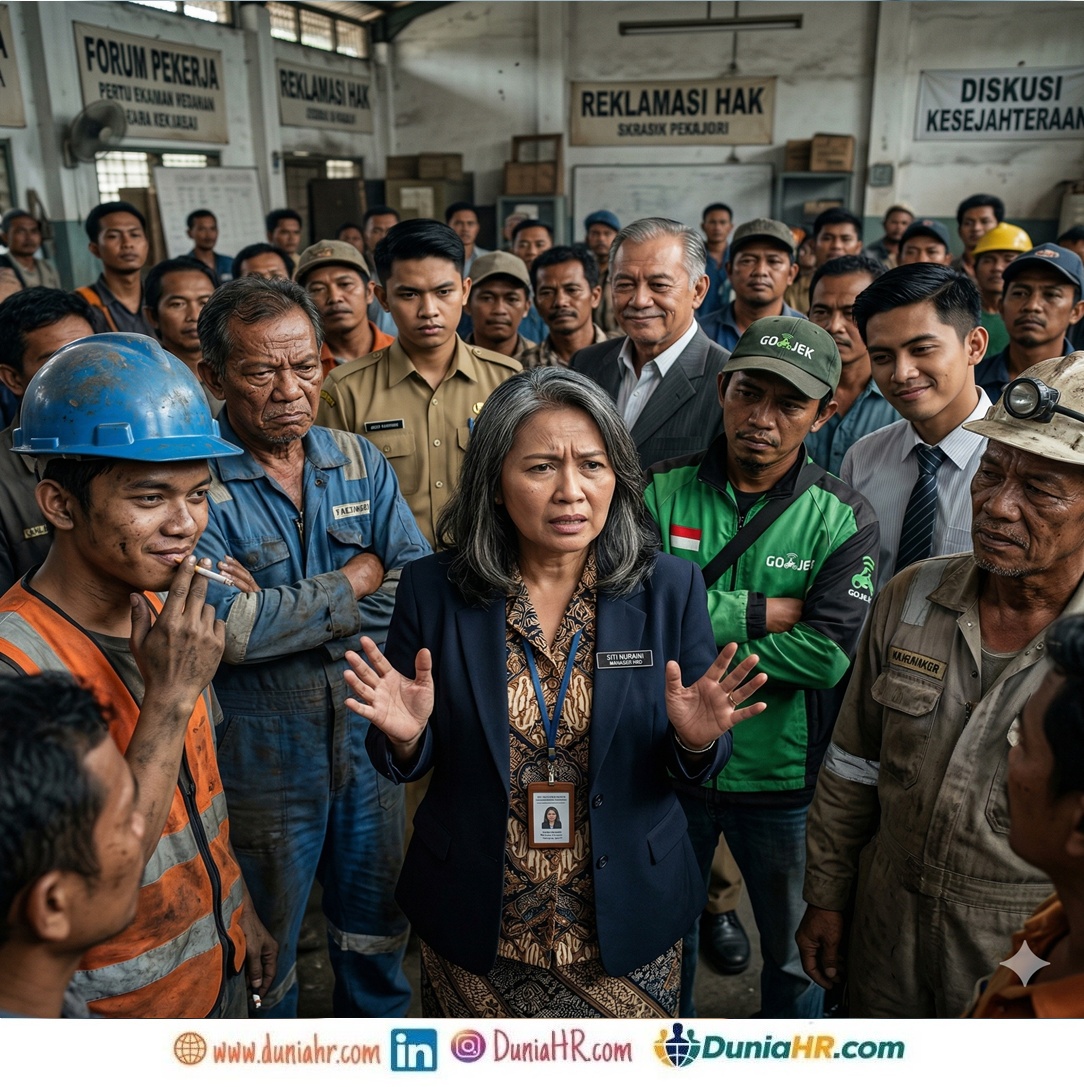

As is well known, positive law in Indonesia is the law that is currently in force, or in Latin, Ius Constitutum. Positive law in Indonesia exists in the form of organic laws and inorganic laws. Organic laws are all laws that regulate matters mandated by the constitution or the 1945 Constitution of the Republic of Indonesia, such as the Manpower Law, the National Education System Law, the Human Rights Law, the Supreme Court Law, and the Constitutional Court Law. while inorganic laws are laws that regulate matters not regulated in the constitution or the 1945 Constitution of the Republic of Indonesia, such as the law on criminal acts of corruption, the law on the eradication of criminal acts of terrorism, and the law on criminal acts of money laundering.
This is an input on GIG Workers, who are currently not explicitly regulated in any law. Some say that GIG Workers are workers with partnership status, while others say that GIG Workers are workers with daily freelance status. In fact, in today’s era of digitalization, GIG Workers have become an option for millennials who are proficient in using devices suitable for choosing work as GIG Workers.
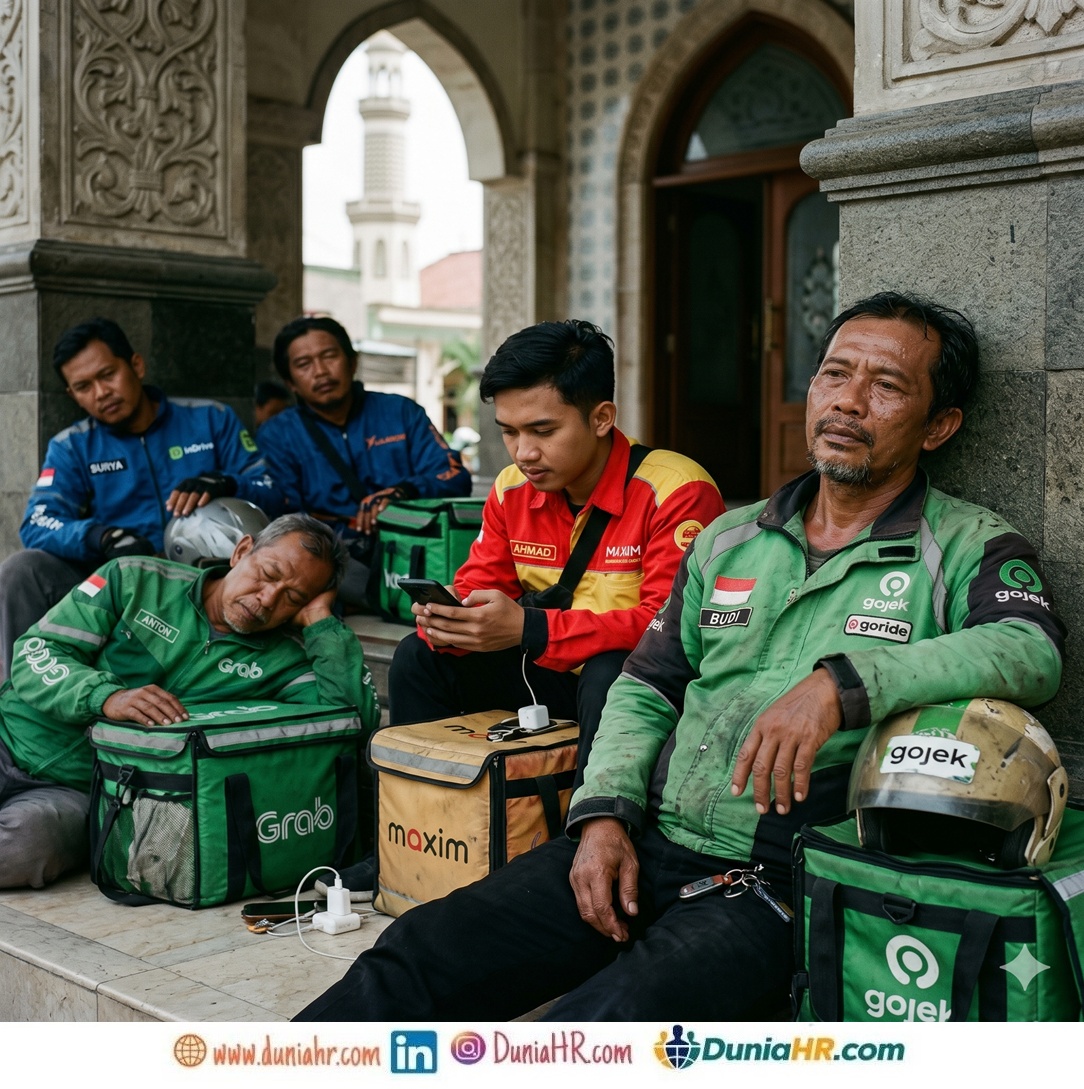
GIG Workers known in Indonesia include content creators, drivers and couriers based on online applications, and similar jobs. Therefore, clear regulations must be established regarding the positive law in Indonesia concerning GIG Workers so that the rights and obligations in performing their work are clearly stipulated in the law. It is recommended that the momentum be utilized in the second draft amendment to Law Number 13 of 2003 on Labor to regulate GIG Workers
GIG Workers Include of The Right of Human Rights
Referred of the Law Number 39, 1999 on Human Rights (“Human Rights Law”) states that every citizen, in accordance with their talents, skills, and abilities, has the right to decent work (Article 38). Human Right Law in Indonesia is type of organic law.
The rationale behind the enactment of Law Number 39 of 1999 on Human Rights is as follows:
- God Almighty is the creator of the universe and all its contents;
- fundamentally, humans are endowed by their Creator with a soul, form, structure, abilities, will, and various facilities to ensure their survival;
- in order to protect, defend, and enhance human dignity, it is necessary to recognize and protect human rights, because without them humans will lose their nature and dignity, which could cause humans to become wolves to other humans (homo homini lupus);
- Because humans are social beings, one human right is limited by another human right, so that freedom or human rights are not unlimited;
- Human rights cannot be taken away by anyone under any circumstances;
- Every human right carries with it the obligation to respect the human rights of others, so that within human rights there are fundamental obligations;
- Human rights must be truly respected, protected, and upheld, and to that end, the government, state apparatus, and other public officials have the obligation and responsibility to ensure the respect, protection, and enforcement of human rights.
In addition, the provisions in the Human Rights Law regarding human rights are determined based on the United Nations Declaration of Human Rights, the United Nations Convention on the Elimination of All Forms of Discrimination Against Women, the United Nations Convention on the Rights of the Child, and various other international instruments governing human rights. The content of this law is also adapted to the legal needs of society and national legal development based on Pancasila and UUD 1945. Thus, this Human Rights Law serves as an umbrella for all laws and regulations concerning human rights. Therefore, direct or indirect violations of human rights are subject to criminal, civil, and/or administrative sanctions in accordance with the provisions of the legislation.
In line with the Human Rights Law, Law Number 13 of 2003 concerning Manpower (“Manpower Law”) stipulates provisions that guarantee the right to work in Article 5: every worker has the same opportunity without discrimination to obtain employment.
It should be noted that labor regulations in Indonesia represent the Indonesian people’s commitment to respecting human rights in the workplace, as recognized in the eight fundamental conventions of the International Labor Organization (ILO). These fundamental conventions consist of four groups, namely: Freedom of Association (ILO Conventions No. 87 and No. 98); Discrimination (ILO Conventions No. 100 and No. 111); Forced Labor (ILO Conventions No. 29 and No. 105); and Child Protection (ILO Conventions No. 138 and No. 182). Indonesia’s commitment to respecting human rights in the workplace is manifested, among other things, by ratifying these eight fundamental conventions. In line with the ratification of these conventions on fundamental rights, the labor laws that are being drafted must also reflect compliance with and respect for these seven fundamental principles.
In summary, the Labor Law in question includes the following:
- The basis, principles, and objectives of labor development;
- Labor planning and labor information;
- Provision of equal opportunities and treatment for workers and employees/laborers;
- Job training aimed at improving and developing the skills and expertise of workers in order to increase work productivity and company productivity;
- Labor placement services in the context of optimal labor utilization and placement of workers in jobs that are in accordance with human dignity as a form of government and community responsibility in efforts to expand employment opportunities;
- Appropriate use of foreign workers in accordance with the required competencies;
- Fostering industrial relations in accordance with Pancasila values aimed at developing harmonious, dynamic, and equitable relations among those involved in the production process;
- Institutional and industrial relations facilities development, including collective labor agreements, bipartite cooperation institutions, tripartite cooperation institutions, industrial relations socialization, and industrial relations dispute resolution.
- Protection of workers/laborers, including protection of the basic rights of workers/laborers to negotiate with employers, protection of occupational safety and health, special protection for female workers/laborers, children, and persons with disabilities, as well as protection regarding wages, welfare, and social security for workers;
- Labor supervision with the aim of ensuring that labor laws and regulations are properly implemented.
Referred of above regulations, so cleary, GIG Workers are Human Rights to citizens for working and decent livelihood. But, it is not clearly regarding of their status, is it include of working agreement based on Man Power Law or partnership agreement based on Civil Law. The Both regulation are same in Positive Law of Indonesia.
GIG Workers on Insight of Manpower Law
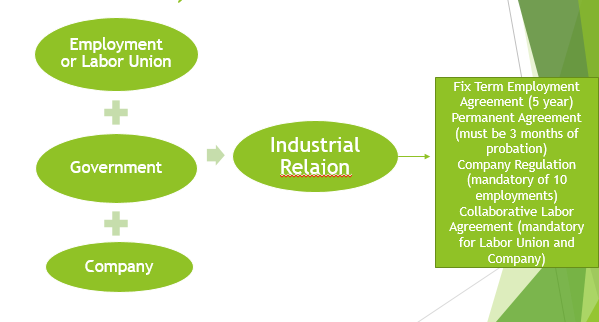
Manpower Law is type of organic law. Man Power Law that regulate there are Company and Labor in work relation. The element of Work Relation are orders, wages and works. It means there are interests between employers/companies and workers/laborers or labor unions in the implementation of work relation. Manpower Law is the heteronom source law with their derivative laws and the otonom source law are work agreement, company regulation and collaborative labor agreement.
Beside of Manpower Law, there is Procedure Law for Dispute of Manpower on Law Number 2, 2004 regarding Dispute Settlement of Industrial Relation. The derivate laws of Manpower Law are Government Regulation Number 34,2021 regarding using of foreign worker, Government Regulation Number 35,2021 regarding Fixed-Term Employment Agreements, Working Hours, Rest Periods, and Termination of Employment, Government Regulation number 36,2021 regarding Wages, Government Regulation Number 37,2021 regarding Implementation of the Job Loss Insurance Program.
In visualization of Manpower Law may describe as follow as :
In connect of above explanation to GIG Workers, then we must to identification their agreement of GIG Workers and their counterpart. On Manpower Law, its state clearly that Work Agreement consist of : (Article 54 Manpower Law)
- name, company address, and type of business;
- name, gender, age, and address of the worker/laborer;
- position or type of work;
- place of work;
- wage amount and payment method;
- working conditions that include the rights and obligations of employers and workers/laborers;
- start date and duration of the employment agreement;
- place and date the employment agreement was made; and
- signatures of the parties to the employment agreement.
Points e and f shall not conflict with company regulations, collective labor agreements, and applicable laws and regulations. The agreement shall be made in at least two (2) copies, each of which shall have the same legal force, and the worker/laborer and employer shall each receive one (1) copy of the employment agreement. Furthermore, work agreements cannot be revoked and/or amended, except with the consent of the parties.(Article 55 Manpower Law) and the Work Agreements are made for a fixed term or for a permanent term. Fixed-term work agreements as referred to in the paragraph are based on a period of time or the completion of a specific job.
In addition, any employment that mean on Manpower Law have right of Social Guarantee. There are manpower social security (BPJS Ketenagakerjaan) and health security (BPJS Kesehatan) (Article 35 Manpower Law). BPJS Ketenagakerjaan and BPJS Kesehatan are regulated on Law Number 24, 2011 Regarding of Social Security Administration Agency (BPJS) and Law Number 40. 2004 regarding National Social Security (SJSN).
Thus, GIG Workers that will regulated by the Manpower Law if they are bound by a fixed-term work agreement or permanent-term work agreement with manpower social security (BPJS Ketenagakerjaan) and health security (BPJS Kesehatan) and the dispute of settlement by Law Number 2,2004 regarding Industrial Relation Dispute Settlement . Exclude of their agreements, it must be referring to the Code of Civil Law of Indonesia (KUHPerdata) as we called partnership agreement.
GIG Workers in insight of Code of Civil of Indonesia
Referring of Academic Paper of Draf Law Regarding Manpower (Naskah Akademik RUU Ketenagakerjaan, August 2025): “there are several characteristics of the gig economy that distinguish it from traditional employment. First, workers provide the capital equipment used directly in their work, such as vehicles for motorcycle taxis or food delivery, or computers and software in other jobs. Second, workers provide their own workplace, which can be their home, a coffee shop, a car, and so on. Third, most jobs are compensated with payments determined according to specific tasks rather than per unit of working time. Fourth, there is a triangular relationship between workers, digital intermediaries, and end users”. It means, there are law relation between GIG Workers and Consumer. In visualitation of their relation as follow as :
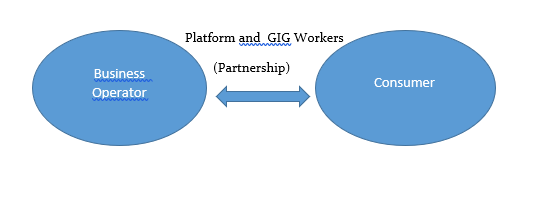
Explanation : regarding Law relation of above as follow as:
- Business Operator with Consumer (directly for purchase good or service), and/or ;
- Business Operator with Platform and GIG Workers (Partnership) with Consumer (In Directly for purchase good or service by Platform and GIG Workers)
So, its clearly civil law of law relation between three parties. There are Business Operatior, Consumer and Platform and GIG Workers (Partnership). Specially for law relation between Platform and GIG Workers are regulate on Article 1320 KUHPerdata. An agreement made by the parties are valid if it comply with the legal requirements of an agreement, which is contained in Article 1320 of the Civil Code, namely:
- There must be consent of the individuals who are bound thereby;
- there must be capacity to conclude an agreement;
- there must be a specific subject;
- there must be an admissible cause;
The explanations for each are as follows:
1. There must be consent of the individuals who are bound thereby;
The parties who make the agreement have agreed or there is a conformity of will or mutually agree with each other’s will, which was born by the parties without coercion, error, and fraud (coercion/dwang, error/dwaling, and fraud/bedrog are 3 things that resulted in an agreement imperfect (Articles 1321 to 1328 of the Civil Code) which agreement can be expressed expressly or tacitly.
2. There must be capacity to conclude an agreement;
Competent (bekwaam) is a general requirement to be able to carry out legal actions legally, which must be mature, have a healthy mind and are not prohibited by a statutory regulation to do certain actions. Article 1330 of the Civil Code states that being incapable of making an agreement is:
- immature people
- those who are put under custody
- women, in matters stipulated by law, and in general everyone to whom the law has prohibited certain agreements.
3. There must be a specific subject
Object of the Agreement between The Parties agreed.
4. There must be an admissible legitimate Cause
According to article 1337 of the Civil Code, a lawful cause or cause means the contents of the agreement does not conflict with laws and regulations, morality and public order. So, every agreed contract remains valid if it fulfills the requirements determined by laws and regulations, public order, and decency.
Terms (1) and (2) are called subjective terms because they relate to the subject who entered into the agreement, while conditions (3) and (4) are called objective terms because they relate to the agreement itself. If the subjective conditions are not met, the agreement can be cancelled by the judge at the request of the party who is incompetent or who gives the agreement freely. The right to request cancellation is limited to 5 years (1454 KUHPerdata). As long as the agreement is not cancelled, it remains binding, while the objective conditions are not fulfilled, the agreement is null and void, meaning that from the beginning there was never an agreement and there was never an engagement.
In addition to Article 1320 KUHPerdata, another important legal basis is Article 1338 KUHPerdata. In Indonesian contract law, the principle of freedom of contract (pacta sunt servanda) is contained in Article 1338 of the Civil Code, which allows each party, in good faith and in accordance with the law, to bind himself in an agreement. The principle of freedom to enter into agreement is contained in Article 1338 of the Civil Code, which contains normative provisions, as follows:
- All contracts entered into lawfully apply as law to those who make them.
- The contract cannot be withdrawn other than with the agreement of both parties, or for reasons which the law deemed to be sufficient.
- Contracts must be carried out in good faith.
Thus, GIG Workers that will regulated by the Code Civil of Indonesia (KUHPerdata), GIG Workers have conduct of Agreement with Platform as Partner not Employee. We called it, Partnership Agreement that valid if all terms on Article 1320 KUHPerdata are fulfill and agreed to perform their right and obligation of GIG Workers and Platform. The revenue of GIG Workers by percentage of commission not based on monthly wages because they free to determine when they start and finish their work. If any arisen dispute of GIG Workers and Platform, they will refer on dispute settlement that agreed on partnership agreement. Normally, they will try to win win solution by amicably and if they fail, they will go to District Court and/or Arbitration.
Ideal Existence for GIG Workers
The positive law of Indonesia must be fulfill of three Law Purpose as follow: justice, benefit and legal certainly. In side of justice, GIG Workers are same like many Workers or Labors as stipulate on Manpower Law. Then, the regulator must regulate of GIG Workers are not only basis of revenue. They need social worker security (BPJS Ketenagakerjaan) and health security (BPJS Kesehatan). Therefore, clearer and more stringent regulations are needed to ensure that gig workers receive their rights as workers, including employment social security (Stevania and Hoesin, 2024).
In other side, it still an option to citizen what they choose of law relation with their each agreements, the first one, it call GIG Workers (protect by Manpower Law) and the second one, it call GIG Partnership (protect by KUHPerdata). In this matters, platform could be the company and/or partner for accomodate this existence.
Impact of GIG Workers
Furthermore, in side of benefits, GIG Workers should become a new field of employment. time flexibility, work electronic agreement and dispute settlement by online. GIG Workers is hope to reduce unemployment and poverty in Indonesia.
Regarding of the new field of employment, it needs to be a commitment to focus on local workers who have been equipped with triple skilling by the government. The first skill relates to vocational training for people who do not yet have skills, the second skill is to improve skills so that they remain relevant to the needs of the times, and the third is a re-skilling program for people who want to switch to new jobs. Of course, the role of the Central Government must be supported by Local Governments, which must require Local Workers in various Business Fields so that it is also beneficial for residents in those areas.
Regarding of the time flexibility, any GIG Workers can do digital-based work, so the work can be done anywhere and anytime, allowing workers to manage their own working hours. They can work from home or from the office.
Regarding of the work electronic agreement, all consent of the working agreement in the employment relationship between GIG Workers and Platforms is through electronic employment agreements, so that the majority of administrative activities are digital-based. Therefore, there needs to be an electronic system that will be used, including in terms of Employment Agreements. However, the essence of this Electronic Employment Agreement must be based on the valid requirements of an Agreement (Article 1320 KUHPerdata) and Freedom of Contract (Article 1338 KUHPerdata).
Regarding the dispute settlement by online, the GIG Workers and Platform as a company can resolve industrial relation disputes online. However, this cannot override the principles of justice. Therefore, if adjusted to the current Industrial Relations Dispute Resolution that regulated on Law Number 2, 2004 and it could eventually develop into Online Bipartite, Online Tripartite (Mediation/Conciliation/Arbitration), including Online Hearings at the Industrial Relations Court (PHI). To date, hearings at the PHI have always been conducted face-to-face in all courts in Indonesia.
The last one, in side of legal certainly, GIG Workers must be regulated on Manpower Law by revision and this includes extending mandatory BPJS participation to gig workers, subsidizing contributions for low-income freelancers, and implementing platform-level accountability for social protections (Alfarizi,M., Noer, Rosdiana. L, Noer, Arifin. B, 2025).
for GIG Partnership it must be regulated on insert of article for GIG Partnership into KUHPerdata from the Government and/or Legislative on Draft of new KUHPerdata that currently being discussed.
Conclusion and Recommendations
GIG Workers must be certainly existence on positive law of Indonesia because GIG Workers are same like many Workers or Labors as stipulate on Manpower Law, GIG Workers include the right of human rights and GIG Workers can make an new impacts to Positive Law Indonesia. The two impacts that related of law relation if they regulated soon as follow as: by work agreements (GIG Workers) or partnership agreements (GIG Partnership).
The recommendations for GIG Worker in positive law in Indonesia are GIG Workers must be regulated by Manpower Law if basis of work agreement and the other one it can be GIG Partnership that regulated on KUHPerdata. So, the Government and/or Legislative must be quick on discussed of the Draft of Revision or Manpower Law and the Draft of new KUHPerdata for increase employment opportunities.
References
Alfarizi,M., Noer, Rosdiana. L, Noer, Arifin. B (2025), Technological Support, Hybrid Work, and National Employment Policies: Catalysts for Worker Productivity and SDG 8 Achievement in Indonesia’s Gig Economy, 14, https://doi.org/10.47198/jnaker.v20i1
Caesaria, Desi.S, Adit, Albertuss (2021), Mau Tahu Pekerjaan yang Cocok di di Era Society 5.0? Simak Ulasannya. https://edukasi.kompas.com/read/2021/01/12/142041671/mau-tahu-pekerjaan-yang-cocok-di-era-society-50-simak-ulasannya?page=all,
Helmi Nasrul, cpl,Letkol (2019), Revolusi Industri 4.0 Dan Pengaruhnya Bagi Industri Indonesia, https://www.kemhan.go.id/pusbmn/2019/04/30/revolusi-industri-4-0-dan-pengaruhnya-bagi-industri-di-indonesia.html
Imanuel, Johan (2018). 4.0 Dalam Hubungan Industrial. Opini Harian Republika, 20 Desember 2018
Imanuel, Johan (2021), Menanti Society 5.0 Dalam Hubungan Industrial. Paper for Presented to 4th P3HKI Conference in Jakarta, 12-13 November 2021
Madfudzoh, S (2019), Siapkah Indonesia Menuju Industri 5.0?, https://analisis.republika.co.id/berita/pwmveb282/siapkah-indonesia-menuju-industri-50-part2
Stevania, Maudy and Hoesin, Siti Hajati (2024), Legal Certainly of Werker Social Security for Gig Worker in Indonesia Gig Worker Era, 276, https://doi.org/10.31289/jiph.v11i2.11968

Johan Imanuel
Advocate, Labor Law Practioner and Observer
| Profil Kontributor |
|---|
| Johan Imanuel, S.H. | Counsel di Adams & Co, Counsellors at Law | Inisiator | Tim Advokasi IR Permenkumham Paralegal | Tim Advokasi Amicus | Tim Advokasi Peduli Hukum Indonesia | Komunitas Advokat Pengawal RUU Hukum Pidana |